




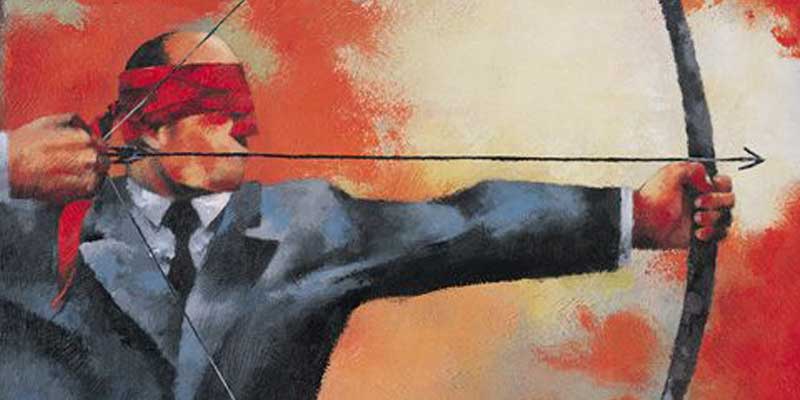
Trust is the fabric that binds us together, creating an orderly, civilized society from chaos and anarchy. If we can’t trust our husband or our wife, if we can’t trust our children, if we can’t trust our boss or our colleagues, if we can’t trust our preacher or our senator, then we have nothing on which to build a stable way of life. Trust is not an abstract, theoretical, idealistic goal forever beyond our reach. Trust—or a lack of it—is inherent in every action that we take and affects everything that we do. Trust is the cement that binds relationships, keeping spouses together, business deals intact, and political systems stable. Without trust, marriages fail, voters become apathetic, and organizations flounder. Without trust, no company can ever hope for excellence.
There has, however, been a deep, fundamental change in the way we view the world today, and, as a result, trust is no longer fashionable. Few adults can remember a world without cynicism. Where “death do us part” once had meaning, today one of two new marriages ends in divorce and countless others exist in name only. Politicians who were once solid members of the community are dropping out of campaigns due to scandals and irregularities. Employees who once believed in devoting their entire working lives to one organization have seen so many colleagues tossed out in restructurings and outsourcings that those who remain are often left emotionally uninvolved in their jobs.
The trust deficit is a sea change from the time when a person’s word was his bond, when employees worked for one company until they retired, when business deals were made on the basis of “I know your father” or “We’ve worked with your company before.” These were all ways of saying we recognize your values, understand how much your reputation means to you, and know how you conduct business. These values resulted in increased business, stronger customer loyalty, better employee morale, reduced turnover, and higher profit margins.
If businesses are to thrive in the global marketplace, trust must be more than something that is talked about; it must be at the core of everything that is done. Organizations cannot be jungles where only the fittest survive, living in a state of battle readiness in order to meet the grueling tests of everyday corporate life.
In organizations, trust is like love in a marriage: it bonds people together and makes them strong and effective. Trust in a relationship increases security, reduces inhibitions and defensiveness, and frees people to share feelings and dreams. Trust empowers you to put your deepest fears in the palms of your colleagues’ hands, knowing that they will be treated with care. Trust enables you to be yourself and maintain your own values without worrying about acceptance. Trust makes colleagues willing to spend time together and make sacrifices for one another. Trust is an expression of faith that makes it easy for colleagues to have confidence in one another’s ability to perform well and to know that they will be there if needed. Trust means that promises made will be kept, and it also means that if a promise is not kept, it was probably for good cause. And finally, trust means that a relationship will last not because it is good business, but because the relationship itself is valued.
Additional Reading:
Creating Trust: A Step-By-Step Guide
How to Build Trust: Creating the Foundation
The Values on Which Trust Rests
Trust: How to Earn Someone’s Faith
Trust Me: 55 Ways to Build Trust and Credibility
If you like this article, subscribe to our blog so that you don’t miss a single post. Get future posts by RSS feed, email or Facebook. It’s FREE. Click your favorite option (top right).

Frank,
From my perspective, trust is a most precious and most fragile thing. In my firm I have 25 people of all ages and from all walks of life. They have all put their trust in me to ensure the company is well run so that their efforts are properly rewarded and so that they can all pay their mortgages, support their families and go to bed each night in the safe and secure knowledge that it will all be there tomorrow.
The weight of that trust often presses on me and, in difficult times, can feel far, far too heavy. However, I too put my trust in my team and I have confidence that they will continue to play their part in making sure we are all striving for the same vision.
I am safe and secure in the knowledge that trust is a two way thing and that everyone in the firm works vigilantly to ensure it is not broken.
Peter
Peter
Your comments are right on the mark 🙂 I believe there’s a direct correlation between trust and the bottom line. It’s very clear that you “get it.” I especially like your comment, “Trust is a two way thing and that everyone in the firm works vigilantly to ensure it is not broken.” Well said!
Have a great day!
Frank
Frank
I observed hundreds of top salespeople interacting with their prospects and customers and took copious notes. About 85% of them were highly trusted by their customers and all the people with whom they worked.
I took my notes to one psychiatrist and two psychologists. They explained how those top salespeople were able to develop deep relationships of mutual trust and respect within a half hour of meeting most people.
The first requirement is that they must be trustworthy people themselves. Then, they ask a series of questions about the prospect that creates mutual emotional intimacy. During that conversation the prospects reveal their level of trustworthiness.
Trustworthy people find that its not difficult to learn. Others can not.
I think that the lack of character and integrity are the primary building blocks that lead to a lack of trust as you so aptly described.
I agree Kevin. Thanks for your thoughts 🙂
Well done Frank! This should be read at the beginning of every school day, opening of Congress and the Senate, and certainly at both Democratic and Republican Conventions. May I have your permission to use it in an Ethics course I’m writing?
It hit home with me on so many levels. “In organizations, trust is like love in a marriage: it bonds people together and makes them strong and effective.” I for years have said the two word, “Love & Trust” are interchangeable.
Thanks for this important piece.
Hi Rossi
I’d be honored you’d use this piece in your ethics course. Please make sure to include the copyright notice. © 2016 Frank Sonnenberg. All rights reserved.
Best,
Frank
I have made it a habit to read your articles whenever I can and this is the weighty phrase that describes a healthy versus an decadent society
“Trust is the fabric that binds us together, creating an orderly, civilized society … (it is an intangible quality of morality, and a foundation ..[my own words] ) on which to build a stable way of life.”
If we could all return to a state where the mind and not the eternal quest after money alone, rules character, and where rectitude is a quality every single person strives for. if this is indeed the case, we have good reason to hope that our society will lead to evolution, not degradation.
I believe we are at that stage, seeing the young people and the new generations demanding accountability and rectitude from all, also our leaders and captains of industry.
I can best phrase my sentiment by referring to a popular 80’s song, “Return to Innocence’ by Enigma.
I call it, a return to conscience, and may it rule from now on and forever.
Hi Eula
Thank you for your continued interest in this site. Your comment is spot on.
There’s been a tendency to judge what the world has become rather than focusing on what we (individually) have become. As I say, “If everyone swept in front of their own door, the world would be a cleaner place.”
Thanks for taking the time to write.
Best,
Frank