




 [pinit count=”horizontal”]
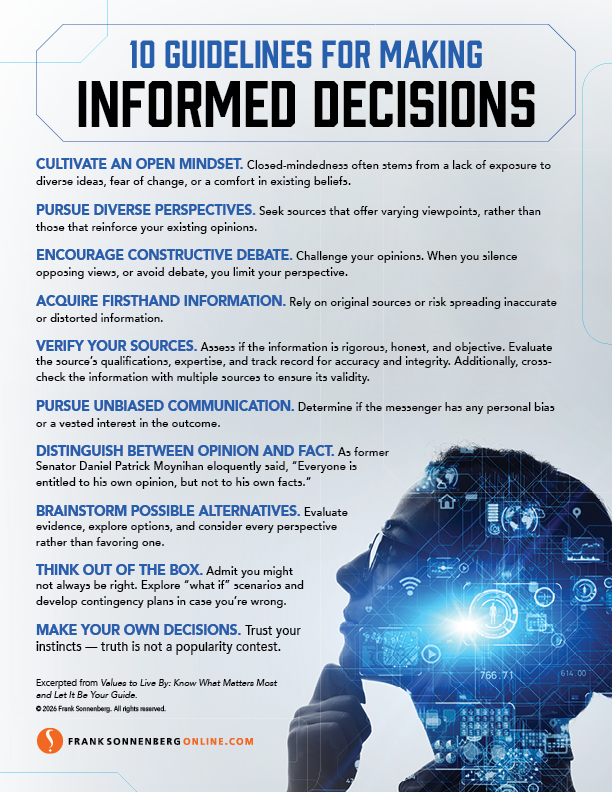
10 Guidelines for Making Informed Decisions
Everyone seems to have strong opinions these days — sometimes, too strong. Many are convinced they’re right, but have they stopped to consider they might be wrong? Probably not. Some people treat everything they hear as gospel without questioning it. When things go wrong, they have built-in excuses — blaming advice from a friend, a website’s recommendation, or research from a prominent journal. They don’t consider that the information might be biased, the research flawed, or the “expert” not an expert after all. Without informed judgment, they can easily mistake opinion for fact. Do you make informed decisions?
If your sources aren’t honest, the responsibility to fact-check falls on you. Acting on erroneous information can damage your credibility, lead to poor choices, trigger missed opportunities, and direct you down dead-end paths. If you care about distinguishing truth from falsehood, evaluate information for accuracy, honesty, objectivity, timeliness, and thoroughness. Be skeptical, do your homework, listen with your mouth closed, and be open to opposing viewpoints to make informed decisions.
10 Guidelines for Making Informed Decisions
Making informed decisions is crucial for success. Here are 10 guidelines to help you navigate an ever-changing world…
Cultivate an open mindset. Closed-mindedness often stems from a lack of exposure to diverse ideas, fear of change, or a comfort in existing beliefs.
Pursue diverse perspectives. Seek sources that offer varying viewpoints, rather than those that reinforce your existing opinions. Remember, surrounding yourself with “yes” people is like talking to yourself.
Encourage constructive debate. Challenge your opinions. When you silence opposing views, or avoid debate, you limit your perspective. If you want someone to agree with you all the time, get a bobblehead.
Acquire firsthand information. Rely on original sources or risk spreading inaccurate or distorted information. Remember the children’s game “telephone,” where players whisper a message from one person to the next, often resulting in humorous distortions.
Verify your sources. Assess if the information is rigorous, honest, and objective. Evaluate the source’s qualifications, expertise, and track record for accuracy and integrity. Additionally, cross-check the information with multiple sources to ensure its validity.
Pursue unbiased communication. Determine if the messenger has any personal bias or a vested interest in the outcome.
Distinguish between opinion and fact. Is the information presented as opinion or fact? As former Senator Daniel Patrick Moynihan eloquently said, “Everyone is entitled to his own opinion, but not to his own facts.”
Brainstorm possible alternatives. Evaluate evidence, explore options, and consider every perspective rather than favoring one.
Think out of the box. Admit you might not always be right. Explore “what if” scenarios and develop contingency plans in case you’re wrong.
Make your own decisions. Trust your instincts — truth is not a popularity contest.
Excerpted from Values to Live By: Know What Matters Most and Let It Be Your Guide
How Do You Make Decisions?
Please leave a comment and tell us what you think or share it with someone who can benefit from the information.

This is an excerpt from Values to Live By: Know What Matters Most and Let It Be Your Guide
Additional Reading:
How to Have a Fresh Perspective
Noise: Loud, Proud, and Often Wrong
Honesty: The Plain and Simple Truth
Protect Yourself from Bad Information
Should Your Viewpoint Matter More Than Mine?
Groupthink: What Makes You Think Others Know Better?
A Game Plan to Encourage Greater Civility
The Benefits of Being Open-Minded: An Open-and-Shut Case
If you like this article, subscribe to our blog so that you don’t miss a single post. Get future posts by RSS feed, email or Facebook. It’s FREE.
Follow me:
Facebook
LinkedIn
X
Pinterest and
Instagram

Leave a Comment